
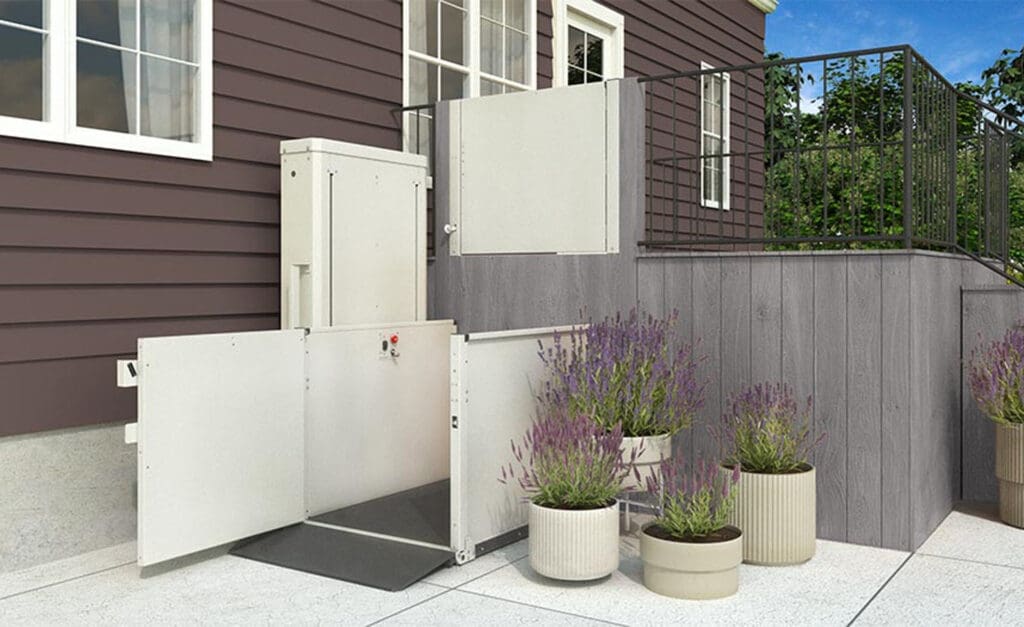
Choosing between a vertical platform lift (VPL)—often known as a porch lift—and a wheelchair ramp is a crucial decision when making your home accessible. The right solution depends on your home’s layout, your mobility needs, and your long-term comfort and safety. At All American Mobility, we understand that this choice isn’t one-size-fits-all. That’s why we offer free, no-obligation in-home assessments carried out by our CAPS-certified, Disabled Veteran-owned team to help you find the best fit.
What Is a Vertical Platform Lift (VPL)?
A vertical platform lift, sometimes called a “porch lift,” resembles a compact elevator that transports a wheelchair user vertically between levels—ideal for front or rear porches, garage entries, or decks. They typically require only a small footprint, such as 5′ × 5′, and can lift users up to 14 feet—enough for most home entryways.
Here’s why VPLs are a compelling choice:
- Compact installation allows space to remain for cars, landscaping, or storage.
- Effortless operation—a simple button press raises or lowers you without physical strain.
- All-weather reliability, with weather-resistant controls and optional enclosures for year-round usability.
Safe and efficient, with protective gates, auto-stop sensors, and secure operation.
What About Wheelchair Ramps?
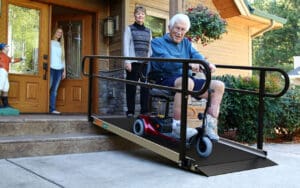
Wheelchair ramps are inclined surfaces that bridge height differences. They’re available in various configurations: permanent, semi-permanent, modular, and portable.(Wikipedia) Here are the benefits they offer:
- Cost-effective for low rises—especially under 18 inches or one to two steps.
- Low maintenance—no moving parts, meaning minimal upkeep.
- Quick to install, especially modular aluminum designs.
However, ramps require space—the ADA‑recommended slope of 1:12 translates to 1 foot of ramp for every inch of rise. For example, a 30‑inch elevation could need a 30‑foot ramp.
Key Differences at a Glance
|
Factor |
Wheelchair Ramp |
Vertical Platform Lift (VPL) |
|
Space Required |
Large—long ramp needed for steep or tall rises |
Small footprint, ideal for limited space |
|
Elevation Covered |
Low rises (<18″ recommended) |
High rises (up to ~14′) |
|
Cost |
Lower upfront cost |
Higher, but efficient for tall rises |
|
Maintenance |
Minimal |
Requires periodic servicing |
|
Ease of Use |
Some effort, especially in poor weather |
Very easy—press button and ride up/down |
|
Weather Resilience |
Exposed—may need winter maintenance |
Weather-protected models available |
When a Ramp Might Be the Right Choice
- Your elevation change is minimal (typically under 18 inches).
- Outdoor space is ample enough to accommodate the ramp length.
- You’re looking for a budget-friendly, low-tech solution.
- You prefer minimal maintenance and upkeep.
When a Vertical Platform Lift Makes More Sense
- Your entryway has a high rise (multiple steps or large elevation).
- Your home layout has limited space, making a ramp impractical.
- You’d prefer effortless access and automation.
- You value weather-resistant functionality and long-term reliability.
In many cases, especially when space is tight or elevation is significant, VPLs are the more viable, safer, and cleaner solution.
Why a Free In‑Home Assessment from All American Mobility Matters
Deciding between a ramp and a VPL is a big step. Here’s how All American Mobility simplifies the process:
- Free, Personal Assessment Our team visits your home to measure, evaluate, and understand your mobility needs—without any obligation.
- CAPS Certification Being CAPS-certified means we’ve been trained—and tested—on the design, safety, and execution of aging-in-place modifications.
- Disabled Veteran-Owned Business When you work with us, you’re supporting a veteran-owned company dedicated to service and integrity.
- Customized Recommendations We’ll explain the best solution—ramp, VPL, or possibly a combined approach—based on your home layout, elevation, health needs, and aesthetics.
- Long-Term Reliability Our solutions are durable, ADA-compliant, and tailored to endure years of use.
- Ongoing Support From installation to service and maintenance, you have a responsive partner for as long as you need.
We’re Happy to Help
Accessibility matters—and making your home wheelchair-friendly is too important to overlook. Between ramp vs. vertical platform lift, there’s no one-size-fits-all answer. The right solution depends on your physical needs, home layout, elevation, and long-term goals.
That’s where All American Mobility steps in—with:
- Free, expert home assessments
- CAPS-certified expertise
- A commitment to accessibility from a Disabled Veteran-Owned business
Let us help you find the perfect fit. Visit us online or contact us to schedule your free assessment. Together, let’s make your home welcoming, safe, and accessible—for you and for all who enter.